Every Virtue Quest session starts the same way. You see a group of students, most of them 11 to 13, powering through a brief but vigorous workout. More impressive than the exercise is the way they’re all moving in sync with one another as the count is called from the front. Then you notice that it’s being led, not by a teacher, but by an older student: their Coach.
The atmosphere is more serious than what you’d typically see with students this age. They look focused. Driven. Then the mood shifts to excitement and fun as they start playing a game that tests their reflexes, memory, creativity — all while keeping them on the move.
Energised and open, they split into pairs and small groups, ready to share stories they’ve researched and enjoy thoughtful conversations about how they might apply the lessons in their own lives. Meanwhile, Coaches prepare the final activity to cap off the session.
The students feel like contestants on a game show as the Coaches present the day’s team challenge. On this occasion, it’s “Lava Drama”. Each team’s spaceship has crash-landed on a tiny island in a lake of lava, and it won’t blast off until they’ve brought back the fuel cells scattered across the floor. Their only way across is a chain of stepping stones (one per person, plus a spare), and only the stone at the back can be passed forward. Within a minute, roles emerge: one student plans the route, another passes stones down the line, a third steadies a teammate who’s wobbling. When a foot touches the lava, the whole team goes back to its island. Nobody blames anyone. They huddle, rethink, and set off again. As the clock runs down, the air fills with shouts of encouragement, and not only for their own team.
Then everyone gathers for the debrief. Each team reflects on what went well, what was hardest, and what they’d do differently. The Coaches add what they noticed: the boy who stayed calm when his team had to restart, the girl who worked out how to retrieve a stone that had landed out of reach. Next week is a fitness test, the Coach reminds them, and a few students share a knowing grin. Some have bronze accents on their black shirts. Others have silver. You can tell they’re all eager to earn the next one. A teacher who’s been watching from the side adds a few words of encouragement. To finish, the whole club kneels in a circle and does a drumroll on the floor with their hands. When the Coach calls “Climbing!”, the drumming stops dead. Everyone then brings one foot forward and forms a huddle. There’s a brief silence as they all check they’re together. Then the whole circle rises as one: “Climb on!”
Nowadays, it’s easy to feel disheartened about the state of the world. Times are getting harder, and the future doesn’t seem to hold the promise it once did. But scenes like this tell a different story. Things get better when people make them better. The people who do are powerful enough to make a difference, and principled enough to make it a good one. Nobody starts out that way. It’s a process: one rep, one conversation, one experience, one choice at a time. Every student in that circle is a hero in the making.
We imagine a world where every young person grows up strong and honourable, ready to take on life’s challenges with confidence and character. Through physical training, brain games, team challenges, and meaningful discussions, they push themselves and support each other to develop virtues — virtues that empower them to thrive and become a force for good in their communities and beyond.
You don’t have to be a star athlete or top of your class. VQ is for any young person willing to work on themselves. When you show up, give your best effort, and support the people around you, great things start to happen.
Student-led, staff-sponsored
Every club is hosted by its school as an extra-curricular activity and run entirely by its own people. Virtue Quest HQ provides the programme and everything else a club needs to run.
Read moreShow less
The Sponsor is a member of school staff who manages the club, recruits and mentors the Coaches, and supervises the sessions.
The Coaches are older students who commit to running the club’s sessions throughout the year. They’re a big part of what makes VQ work. Younger students take their lead from someone a few steps ahead, and the best way to learn something is to teach it. So Coaches grow as much as anyone, and a year of service earns them the Coach Award.
The younger students in their charge are called Climbers, because personal growth is a climb. Nobody is carried to the top. Nobody gets there in one leap. Every step is earned. Climbers go at their own pace, but they don’t climb alone. They support each other through the hard parts and celebrate each milestone together.
The Bronze, Silver, and Gold Climber Awards are the stages of the climb, and every summit reveals a bigger mountain. The mountain gets bigger. So do you.
The Four Pillars
VQ is built on four pillars that help you find your FEET:
- Fitness
- Executive Function
- Ethics
- Teamwork
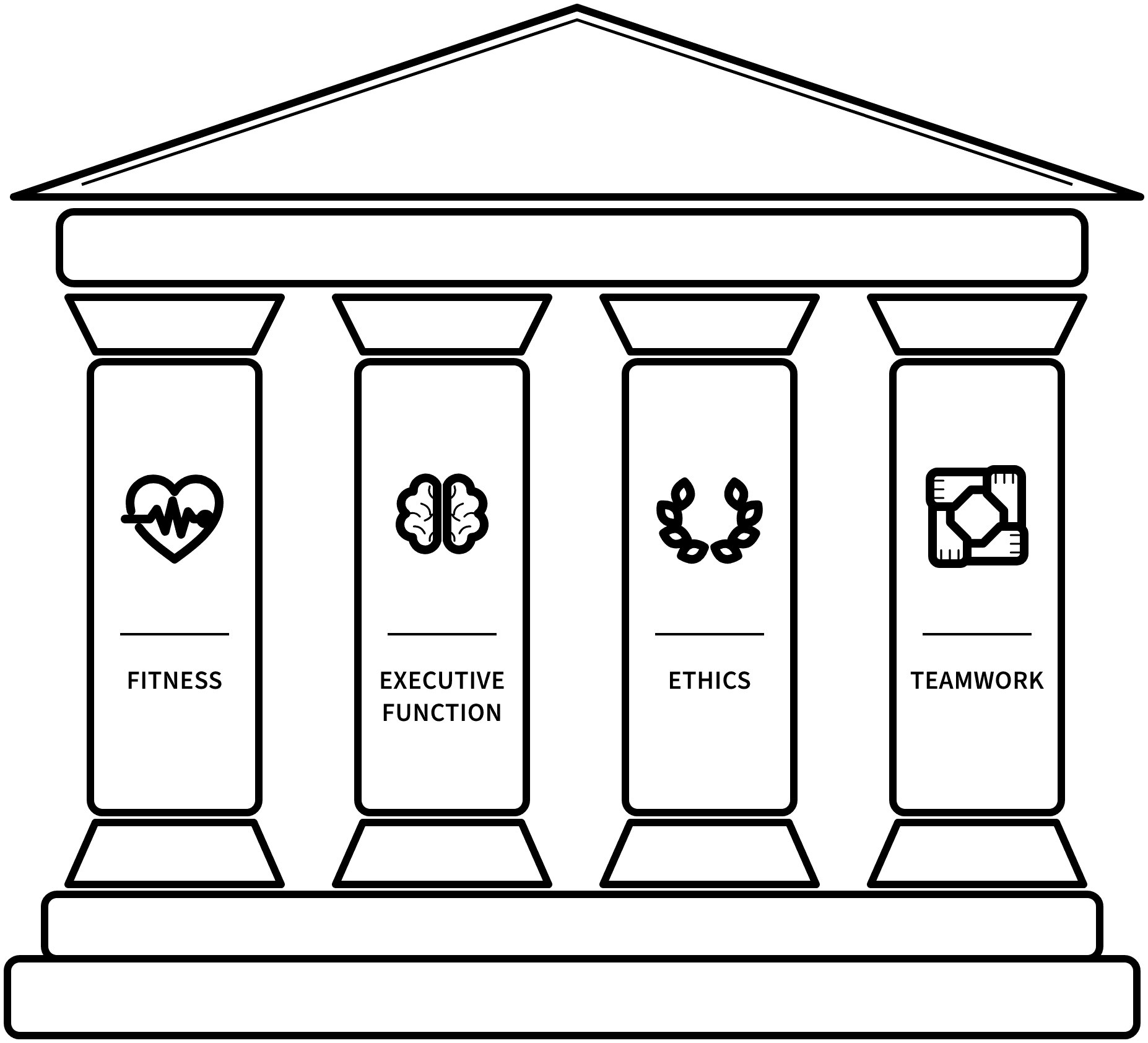
Read moreShow less
Fitness
Fitness is the foundation everything else depends on. It strengthens and protects your body, and it boosts your mood, energy, confidence, and brain power. VQ fitness covers mobility (moving freely, like touching your toes or sitting in a deep squat), strength (bodyweight exercises like squats, push-ups, and pull-ups), and endurance (a fit heart and lungs). Being active is not the same as being fit. That’s why we have objective and attainable fitness standards, each linked to a meaningful health outcome.
Executive Function
Executive Function (EF) is the set of mental skills that help you stay focused, solve problems, and reach your goals:
- Self-Control helps you manage impulses and do the right thing, even when it’s hard.
- Working Memory is your mental notepad: it holds information while you use it.
- Cognitive Flexibility helps you adapt to change and find new solutions.
The good news: EF can be built, both through the games we play in club sessions and through everyday habits like sleep, exercise, and time away from screens.
Ethics
Think of someone who just makes a room better. You notice it before they say a word: they carry themselves well, full of good energy yet completely at ease. They’re sharp, but they listen. They notice when someone’s left out and stay calm when things get tense. Somehow, everyone around them raises their game. They weren’t born that way. They became that way, one choice at a time.
The personal qualities that help you be at your best and bring out the best in others are what we call virtues. Some are strengths, like discipline and resilience. Others are matters of honour, like integrity and kindness. In Virtue Quest, we explore them one at a time: what each virtue looks like, what stands in its way, and how to cultivate it in ourselves. The aim is to go from knowing the good, to loving the good, to doing the good.
Teamwork
Team sports don’t automatically produce team players. Real teamwork means listening, playing to everyone’s strengths, and keeping your head when things don’t go according to plan. It means being supportive of both your teammates and your opponents — because the better they get, the more everyone gets out of the experience.
In VQ, you’re in a newly mixed team for every Challenge. The aim isn’t just to win. It’s to become the kind of person who is respectful, reliable, team-oriented, supportive, and composed.
The Session
Every session follows the same shape, so Climbers know what’s coming and can put their energy into the work. It runs about an hour, in three parts: Boost, Ethics, and Challenge or Milestone.
Read moreShow less
Boost wakes up the body and the brain, and turns a group of individuals into a club. Training together, in sync, is both a primer and a leveller: everyone finishes energised, humbled, and bonded. Then teams play a lively EF Game that takes focus, memory, flexible thinking, or all three.
Ethics is a conversation. Before each session, every Climber prepares a Virtue Card: studying one virtue and finding their favourite story of it in action. In pairs, they share what they wrote and explore some questions together. Then one virtue is picked as the Virtue of the Day, and a Climber shares a highlight from their conversation with the whole group.
Challenge sessions end with a team task that needs everyone. Each Challenge promotes communication, problem-solving, collaboration, and composure. Afterwards, teams reflect on what went well, what was hard, and what they’d change.
Milestone sessions typically happen every fourth week, replacing the Challenge with a test of one pillar: Fitness, Executive Function, or Ethics. It’s the Climbers’ chance to meet the standards for their next award.
The Awards
Each award marks a stage of the climb. To earn one, a Climber must achieve every milestone for that level across all four pillars, as well as meet the club’s standards for attendance and conduct.
Read moreShow less
Nobody gets an award just for turning up. Every Climber is held to the same objective standards, so when you meet someone with a Virtue Quest Award, you know exactly what it means.
Each award demands more than the last. No single milestone is out of reach, but everyone has their own mix of strengths and weaknesses, so most Climbers have at least one area to work on before they meet every standard. That’s normal. It’s part of the climb.
Coaches run the tests and keep the records. The Sponsor checks them and nominates each Climber who has met all the criteria, and HQ confirms the awards. Climbers are recognised on the Virtue Quest website and presented with their award at the club: a certificate, a new shirt in their award’s colour, and their guide to the next level.
Coaches work towards the Coach Award over their year of service. It recognises their commitment and leadership: running sessions, giving presentations, organising the Club Showcase, and supporting the growth of both the club and its members, all recorded in a Coach Portfolio.
The Year
The year follows a simple rhythm: three Challenge sessions, then a Milestone.
Read moreShow less
Three of these cycles make a phase, and the Milestones rotate through Fitness, Executive Function, and Ethics, so each of these pillars is tested once a phase. Teamwork is assessed cumulatively across every Challenge session. A Climber who misses a milestone gets another chance in the next phase, and progress carries over from one year to the next.
Every club runs the same Challenges in Phase 1. Beyond that, each club’s activities change based on its own Climbers’ ratings, with EF Games swapped every few weeks and Challenges each phase, so the programme evolves with the people in it.
The year ends with the Club Showcase, organised by the Coaches. Families, friends, and future members come to see what the club does, celebrate the Climbers’ awards, and hear the Coaches reflect on their year.